Traditional RPA works well when a process is stable, the interface rarely changes, and the automation team has time to build and maintain detailed rules.
Android app workflows are often less stable. Apps update. Popups appear. Buttons move. Login state changes. Network delays create small timing problems. That is why AI-assisted script generation is becoming more useful for cloud phone work.
The short version
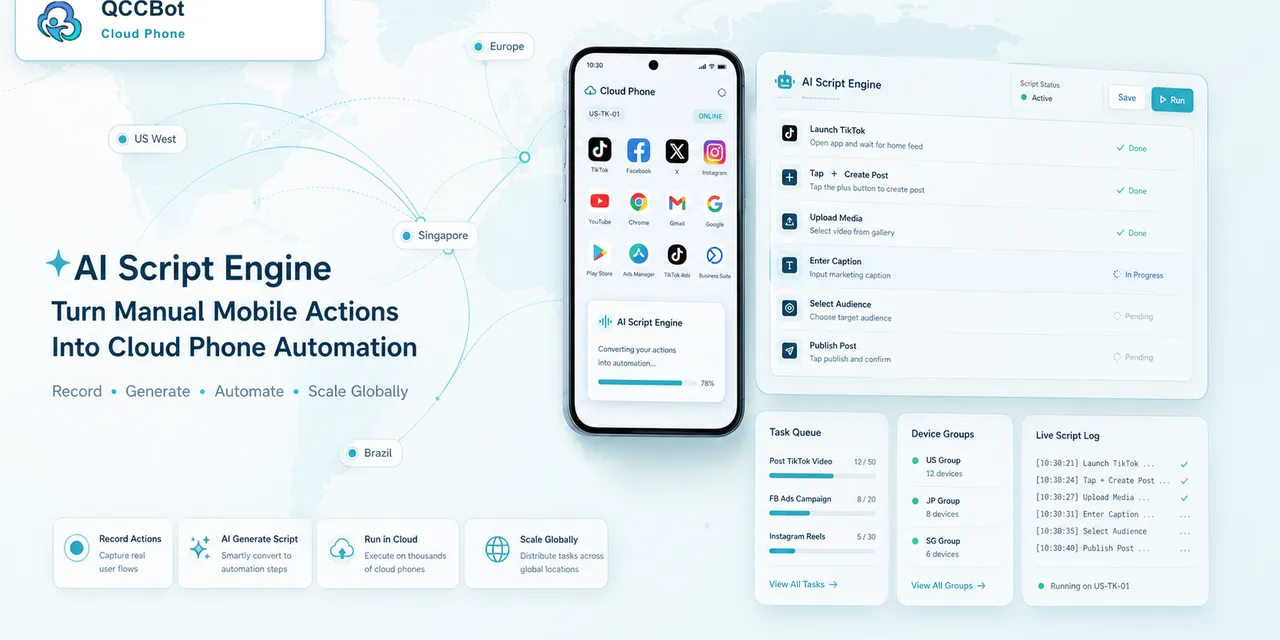
Traditional RPA is rule-first. An AI script engine is intent-first. With QCCBot, an operator can describe the mobile task, generate an AutoJS script, test it on cloud phones, and use AI help when errors appear.
Where traditional RPA struggles
RPA is strong when the environment is predictable. A finance form, internal web dashboard, or desktop workflow can often be described step by step.
Mobile apps introduce more variability:
- frequent UI changes;
- app permission prompts;
- login expiration;
- region differences;
- loading delays;
- popups that only appear on some accounts;
- flows that depend on app state.
When one small detail changes, a rule-based script may stop.
What an AI script engine does differently
An AI script engine does not remove scripting. It makes scripting easier to create, inspect, and improve.
For example, a team can write:
“Open the app, check whether the account is logged in, close common popups, go to the upload page, and record whether the upload button is available.”
The AI can turn that request into a script draft. The team then tests it, reviews the result, and adjusts the workflow.
The human role is still important
AI-generated scripts should not be treated as magic.
Operators still need to define:
- what success means;
- which screens are normal;
- which exceptions are safe to recover;
- which cases require human review;
- which accounts or tasks are too sensitive for automation.
The advantage is that the team spends less time starting from a blank file and more time improving the workflow.
A practical workflow
- Describe the task in plain language.
- Generate the first AutoJS script with AI.
- Run it on a small cloud phone group.
- Review the logs and screenshots.
- Fix high-frequency failures.
- Enable AI takeover only for safe exception types.
- Expand to more devices after results are stable.
This is more realistic than trying to automate every case on day one.
Where QCCBot fits
QCCBot combines Android cloud phones with xeasy code AI script generation and AI-assisted debugging. This helps teams move from manual app operation to repeatable AutoJS workflows without turning every operator into a full-time automation engineer.
For teams evaluating AI-assisted Android automation, QCCBot’s official website explains how its AI script engine and cloud phones work together for mobile workflows.
FAQ
Is AI script generation the same as no-code?
Not exactly. It reduces the amount of code a person needs to write, but good automation still needs testing, review, and operating rules.
When is traditional RPA still better?
Traditional RPA may be better for stable desktop or web workflows with strict compliance requirements and mature process documentation.
When is an AI script engine better?
It is useful when mobile app workflows change often and operators need faster script creation, debugging, and exception handling.