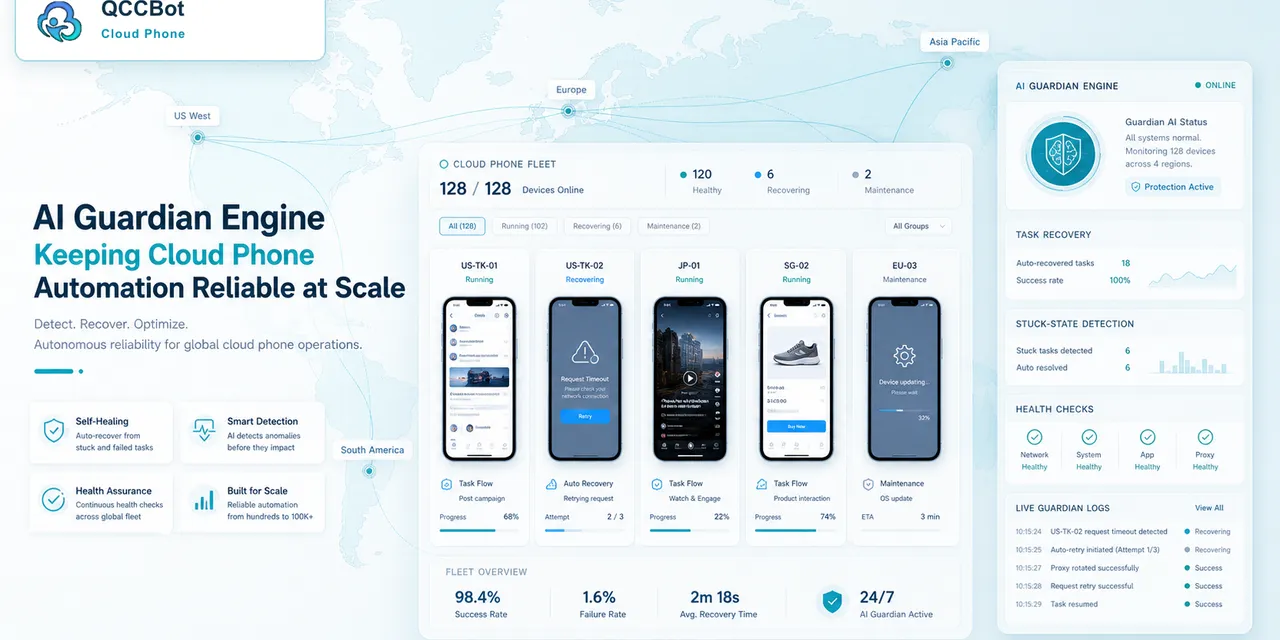
The more capable AI agents become, the more teams need to talk about brakes. Google DeepMind’s recent AI Control Roadmap is one signal that the industry is moving from “make agents powerful” toward “make agents observable, limited, and controllable.”
That may sound negative, but it is actually what makes AI useful in real operations. A tool that can help recover a failed task is valuable. A tool that keeps acting without knowing whether the screen is safe is a liability.
This is especially true for cloud phone automation. Mobile apps include login states, private messages, payment screens, security prompts, account recovery flows, and one-way actions. A useful AI system should know when to help and when to stop.
That is why controlled takeover matters.
AI takeover is not the same as full autonomy
In a cloud phone workflow, AI takeover should not mean “AI controls the phone forever.”
A better definition is:
AI takeover is a controlled recovery mode that lets the system handle selected, known, low-risk exceptions during a script run, while logging what happened and stopping at sensitive or unknown states.
That definition matters because many failures are not equal.
A slow-loading page may be safe to retry. A known permission popup may be safe to close. A new security warning should not be guessed through. A login recovery screen should not be handled as if it were a harmless popup.
The common mistake: one failure bucket
Many automation systems treat failure as a single state.
The script passed, or the script failed.
That is not enough for real mobile operations. A failed cloud phone task may mean:
- the app loaded slowly;
- the button moved;
- the account was logged out;
- a permission prompt appeared;
- the app version changed;
- the proxy or region is wrong;
- a security screen appeared;
- the script started from the wrong page.
These cases need different responses. If the system only says “failed,” the operator has to open devices manually. If the system classifies the failure, the team can decide what AI may recover and what humans should review.
A practical recovery model
Controlled AI takeover works best when the team defines categories before scaling the workflow.
| Failure type | AI can often help with | AI should stop when |
|---|---|---|
| Loading delay | Wait, retry, record delay | Repeated retries fail |
| Known popup | Close or handle by approved rule | Popup is unfamiliar |
| UI drift | Capture context, suggest script fix | Screen is unknown |
| Permission prompt | Apply approved permission rule | Permission changes account risk |
| Login or recovery | Flag human review | Credentials or verification are involved |
| Security prompt | Preserve context | Human judgment is required |
This table is not only a technical rule. It is an operating policy.
Why a separate switch matters
QCCBot’s AI exception takeover is designed with a separate switch because teams should decide when recovery is allowed.
That sounds simple, but it changes the trust model.
Without a separate switch, operators may worry that AI will interfere with every script run. With a separate switch, AI recovery becomes an intentional mode. The team can choose which tasks, devices, and exception types are suitable for AI assistance.
That is closer to how real operations teams work. Some tasks are safe to recover automatically. Some tasks should only be observed. Some tasks must stop for a human.
Logs make AI recovery reviewable
AI recovery without logs is hard to trust.
If a task completes after AI takeover, the team still needs to know:
- what failed first;
- what action AI took;
- whether the action matched an approved rule;
- whether the task continued normally;
- whether the same issue is repeating across devices.
This is why task logs are not a minor feature. They are the record that lets the team improve the workflow instead of hoping the AI did the right thing.
Where QCCBot fits
QCCBot combines the pieces needed for controlled recovery:
- cloud phones for real Android app execution;
- AutoJS scripts for repeatable mobile tasks;
- xeasy code AI for script generation and debugging;
- AI Guardian-style monitoring for stuck or abnormal tasks;
- task logs for review;
- a separate AI takeover switch for selected exception handling.
The goal is not to make AI sound fearless. The goal is to make it useful under clear rules.
The better story for AI operations
The strongest AI products will not be the ones that promise total autonomy first. They will be the ones that make autonomy reviewable, limited, and useful.
For mobile app workflows, that means AI should help operators see what happened, recover what is safe, and stop when judgment is needed.
That is the difference between risky automation and operational automation.
If your team wants AI assistance without losing control of mobile workflows, visit the QCCBot website to see how cloud phones, AutoJS scripts, task logs, and controlled AI takeover work together.
FAQ
What does AI takeover mean in QCCBot-style cloud phone automation?
It means AI can help recover selected script exceptions when the team allows it. It should be treated as controlled recovery, not unlimited autonomous control.
Why does AI takeover need a separate switch?
A separate switch lets teams choose when AI recovery is allowed. That keeps sensitive workflows under human control and makes AI assistance more intentional.
Which failures should stay manual?
Login recovery, payment, identity verification, account security prompts, private messages, and unfamiliar screens should stay manual or require human review.