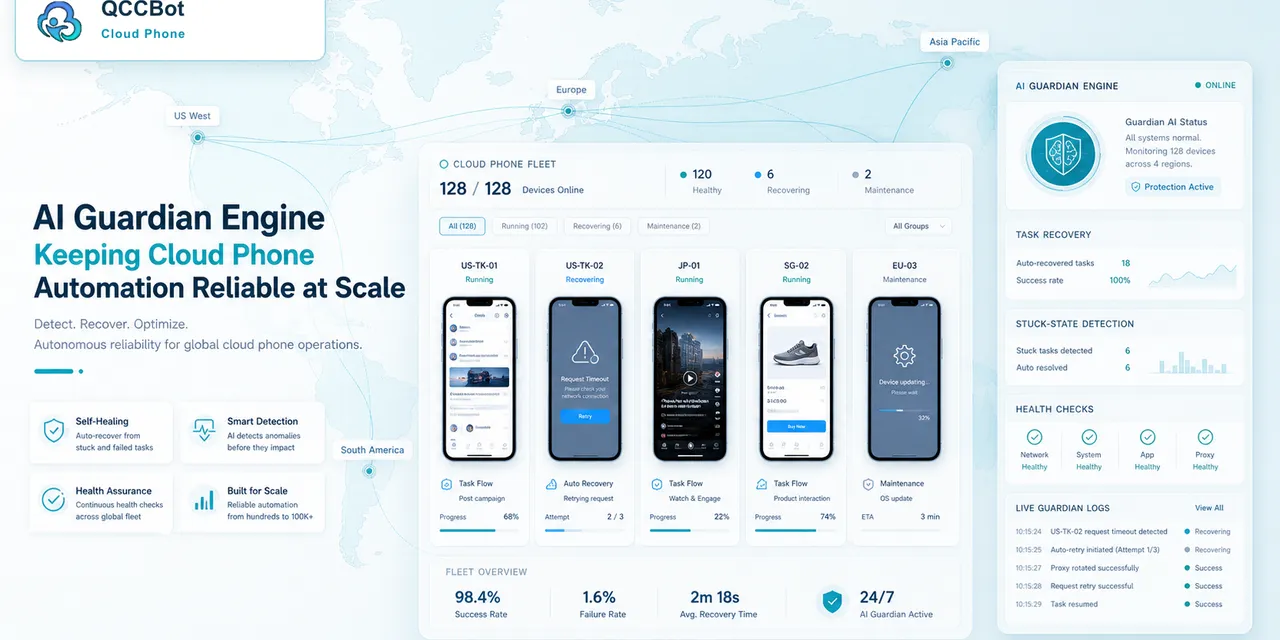
The agentic AI conversation has moved quickly. Recent developer events have focused on agents that can build, act, coordinate, and use tools.
That is important. But teams running mobile work still face a grounded question:
Who handles the mobile operations layer?
An agent can plan a task. It may call APIs. It may control a browser. But many business workflows still end up inside Android apps where state, accounts, popups, and device conditions matter.
What people search when agent demos meet mobile reality
Searches may include:
- AI agent for mobile app workflow
- agentic apps still need Android automation
- AI agent can use browser but not phone app
- mobile operations layer for AI agents
- Android cloud phone for agent workflows
This is where QCCBot has a natural role.
The mobile operations layer means three things
First, the task needs an Android environment.
Second, the workflow needs a repeatable way to run inside the app.
Third, failures need to be visible and recoverable.
Without those three pieces, the AI agent can be smart and still fail at the point of execution.
Why APIs are not enough
APIs are great when they exist and cover the full workflow.
But mobile teams often work with:
- third-party apps;
- seller apps;
- social apps;
- testing apps;
- internal Android tools;
- marketplaces where important flows are app-first.
In those cases, the screen is part of the workflow. The system needs to see what happened, not only call an endpoint.
A practical architecture
A realistic agent-to-mobile workflow can look like this:
- The agent receives the task.
- The workflow maps the task to a known mobile process.
- QCCBot runs the process on a cloud phone group.
- AutoJS handles repeatable steps.
- AI helps generate or repair the script.
- Logs and screenshots describe what happened.
- Sensitive exceptions stop for human review.
This architecture keeps the agent useful without pretending mobile apps are perfectly predictable.
Where QCCBot fits
QCCBot gives the execution layer for Android app work.
It is not just a cloud phone panel. It combines:
- cloud phones;
- script execution;
- AI AutoJS generation;
- AI debugging;
- optional AI takeover;
- task logs;
- device grouping.
That combination is useful when agents need to act in mobile app environments rather than only websites or APIs.
What good teams should define
Before adding agents to mobile work, define:
- which tasks are safe to automate;
- which app states are expected;
- which failures can be retried;
- which failures should stop;
- what logs operators need;
- who reviews sensitive states;
- how to test new scripts before scale.
This is not bureaucracy. It is the difference between a demo and a workflow people trust.
Final takeaway
The agentic software trend is real, but mobile execution remains a practical bottleneck. Teams that work inside Android apps need a mobile operations layer with devices, scripts, logs, and recovery.
If your agent strategy still has work trapped inside phone apps, QCCBot can help turn those mobile steps into observable cloud phone workflows.
Reference: Microsoft Build 2026 agentic platform overview: https://blogs.microsoft.com/blog/2026/06/02/ai-alone-wont-change-your-business-the-system-running-it-will/
What the operations layer should report
The mobile operations layer should not only say that a task failed.
It should report:
- task started;
- device group used;
- account group used;
- script version;
- current screen;
- last successful step;
- failure reason;
- retry attempts;
- AI recovery attempts;
- review status.
This level of reporting matters because agent workflows can involve many moving parts. If the mobile step fails, the team needs to know whether the failure came from the app, the account, the script, the device, the network, or the agent plan.
A workflow owners can actually manage
Assign ownership by category:
- operators handle ready and routine states;
- account owners handle login and verification;
- script owners handle selector and UI changes;
- managers review risk categories and throughput;
- AI assists with classification and debugging.
This prevents every failure from becoming a developer interruption. It also keeps AI from being treated as the owner of business decisions.
Why this becomes more important as agents improve
The better agents become at planning, the more visible the execution bottleneck becomes. A weak execution layer wastes the value of a good plan.
For mobile work, execution means Android environments, scripts, logs, screenshots, and stop rules. That is why cloud phone automation remains relevant even as high-level agent platforms improve.
A good first buyer question
When a buyer evaluates an agent platform, they should ask one very practical question: “What happens when the task reaches a mobile app?”
If the answer is unclear, the workflow probably has an execution gap. The team may still need people to open phones, check screens, and report failures manually.
QCCBot is strongest in that gap. It gives the agent strategy a place to run Android steps and a way to turn mobile failures into structured information.